
Taj Mahal: India’s Eternal Symbol of Love and Beauty
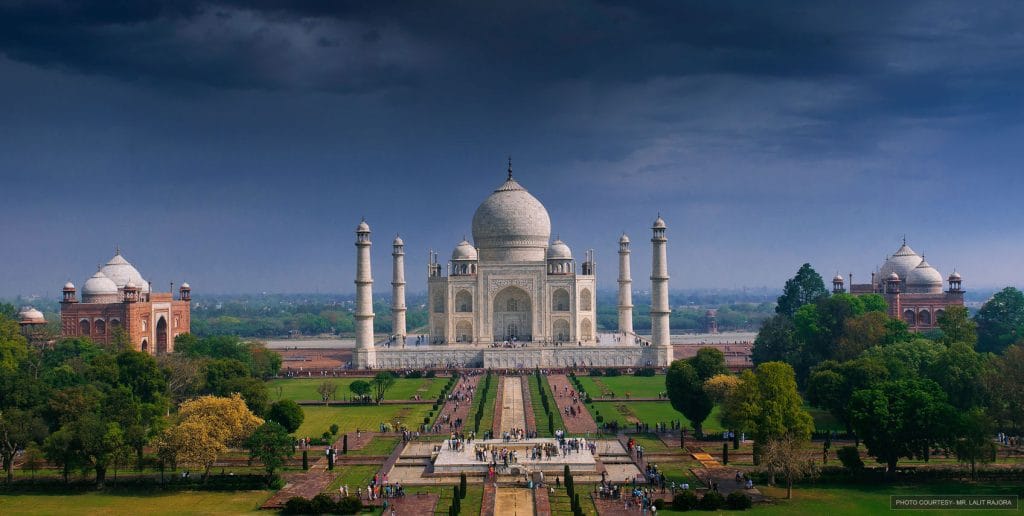
The Taj Mahal (Urdu: تاج محل) is a World Heritage mausoleum located in the city of Agra in the Indian state of Uttar Pradesh, and one of the 7 wonders of the world. It was built in the 17th century by the Mughal emperor Shah Jahan in memory of his wife Mumtaz Mahal.
Mughal architecture was at its peak during the time of Mughal emperor Shah Jahan, Taj Mahal is the most famous example of all those architectures. Taj Mahal is an excellent example of Mughal architecture. Its architectural style is a unique combination of Persian, Turkish, Indian and Islamic architectural elements. In 1983, Taj Mahal became a UNESCO World Heritage Site. Along with this, it was described as one of the best human creations that has received universal praise in the World Heritage. Taj Mahal has also been declared the jewel of Islamic art of India. Its white dome and tile-shaped structure are covered with marble, instead of being built like the buildings usually seen, which are covered with large layers of marble slabs. The tomb built in the center introduces a combination of beauty in its architectural excellence. The special thing about the structure of the Taj Mahal building complex is that it is completely symmetrical. Its construction was completed around 1648. Ustad Ahmad Lahori is often considered its chief designer. The construction of the Taj Mahal took approximately 22 years.
The Taj Mahal complex can be divided into five main parts:
-
- Chandni Bagh, north of the Yamuna river
-
- River-facing terrace, which houses the main tomb, mosque and Jawab buildings.
-
- Charbagh area, which houses pavilions.
-
- Jilukhana, which houses the tomb’s attendants and other secondary tombs.
-
- Tajganji, which was originally a market and a caravansary for the workers of that time, and now only a few ruins remain. The big gate is situated between Jilukhana and the garden.
The ground level gradually decreases from Tajganji towards the river. In the list and descriptions of other contemporary constructions in the complex, they are mentioned from the river terrace part in the direction of Tajganji.
Tomb
Floor plan map of Taj Mahal
The centrepiece of the Taj Mahal is the white marble tomb built on a square foundation. It is a symmetrical building with an iwan, a huge arched entrance. The building is crowned by a large dome. Like most Mughal tombs, its basic elements are of Persian origin.
Mula-pada
The Mula-pada is a massive multi-chambered structure. The main chamber is cubical, 55 metres on each side (see: floor plan, right). The long sides have a massive pishtaq, or arched-roofed chamber entrance. It is joined by an arched balcony above.
Main arch
On either side of the main arch, two additional pishtaqs are built in a one above the other style. In the same style, two pishtaqs (one above the other) are built on the four sides of the chamber. The design is completely symmetrical on each side of the building, which makes the building octagonal rather than square, but since the four sides on the corner are much smaller than the other four sides, it would be appropriate to call it square. The four minarets around the tomb, at the four corners of the main base platform, seem to bind the view of the building in a frame. The main chamber contains the fake tombs of Mumtaz Mahal and Shah Jahan. These are highly decorated, and the real ones are located on the lower floor.
Dome
The most magnificent part of the tomb is the marble dome (see left), which is the highest adornment on the tomb. Its height is 35 meters, almost equal to the base of the building, and it stands on a 7 meter high cylindrical base. It is also called onion-shaped (also called guava-shaped) dome due to its shape. Its peak is decorated with an inverted lotus. It joins the edges of the dome at the peak.
Umbrellas
The shape of the dome is further strengthened by four small domed umbrellas (see right) located on its four sides. The domes of the umbrellas are copies of the shape of the main dome, the only difference is in size. Their pillar-like bases are open on the roof to provide internal lighting. Tall decorated marble vases further emphasize the height of the dome. Along with the main dome, the lotus-shaped peak also adorns the umbrellas and vases. A metallic urn, a famous element of traditional Persian and Hindu architecture, is adorned in the form of a crown on the peak of the dome and umbrellas.
Kireet Kalash
There is a urn on the crown of the main dome (see right). This Shikhara Kalash was made of gold till the early 1800s and now it is made of bronze. This Kirit-Kalaash is an integrated combination of the elements of Persian and Hindu architecture. It is also found on the top of Hindu temples. The Kalash has a moon on it, whose tip points towards the sky. Due to its placement, the moon and the tip of the Kalash together form the shape of a trident, which is the symbol of the Hindu god Shiva.
Minarets
Four huge minarets (see left) are located at the four corners of the main base. Each of them is 40 meters high. These minarets show the symmetrical trend of the design of the Taj Mahal. These minarets are built in the same way as the minarets built for giving Azan in the mosque. Each minaret is divided into three equal parts by two balconies. Above the minaret is the last balcony, on which the chhatri is built like the main building. The same lotus-shaped figure and crown vase are also present on them. There is a special thing about these minarets, all four of them are slightly inclined towards the outside, so that in case of a fall, they fall outwards only, and the main building does not get damaged.
External ornamentation
Calligraphy on the big Pishtaq
The external ornamentation of the Taj Mahal is the best example of Mughal architecture. As the surface area changes, the area of the big Pishtaq is more than the small one and its ornamentation also changes in the same proportion. The ornamentation elements are made of lacquer or stucco or by carving and inlaying gems. The restriction of anthropomorphic figure of Islam has been fully followed. The ornamentation has been done only with calligraphy, formless, geometric or plant motifs.
The calligraphy found in the Taj Mahal is of the florid Thuluth script. These were created by the Persian scribe Amanat Khan. This calligraphy has been done by inlaying jasper in white marble slabs. The work done on the marble cenotaph is extremely delicate, soft and fine. Height has been taken care of. On the higher slabs, the writing has been done in a proportionately bigger size so that it does not appear crooked when viewed from below. Verses from the Quran have been used for decoration in the entire area. Recent research has revealed that Amanat Khan had also selected those verses.